Why Did GOD Say “Let US Make Man in OUR Image”?
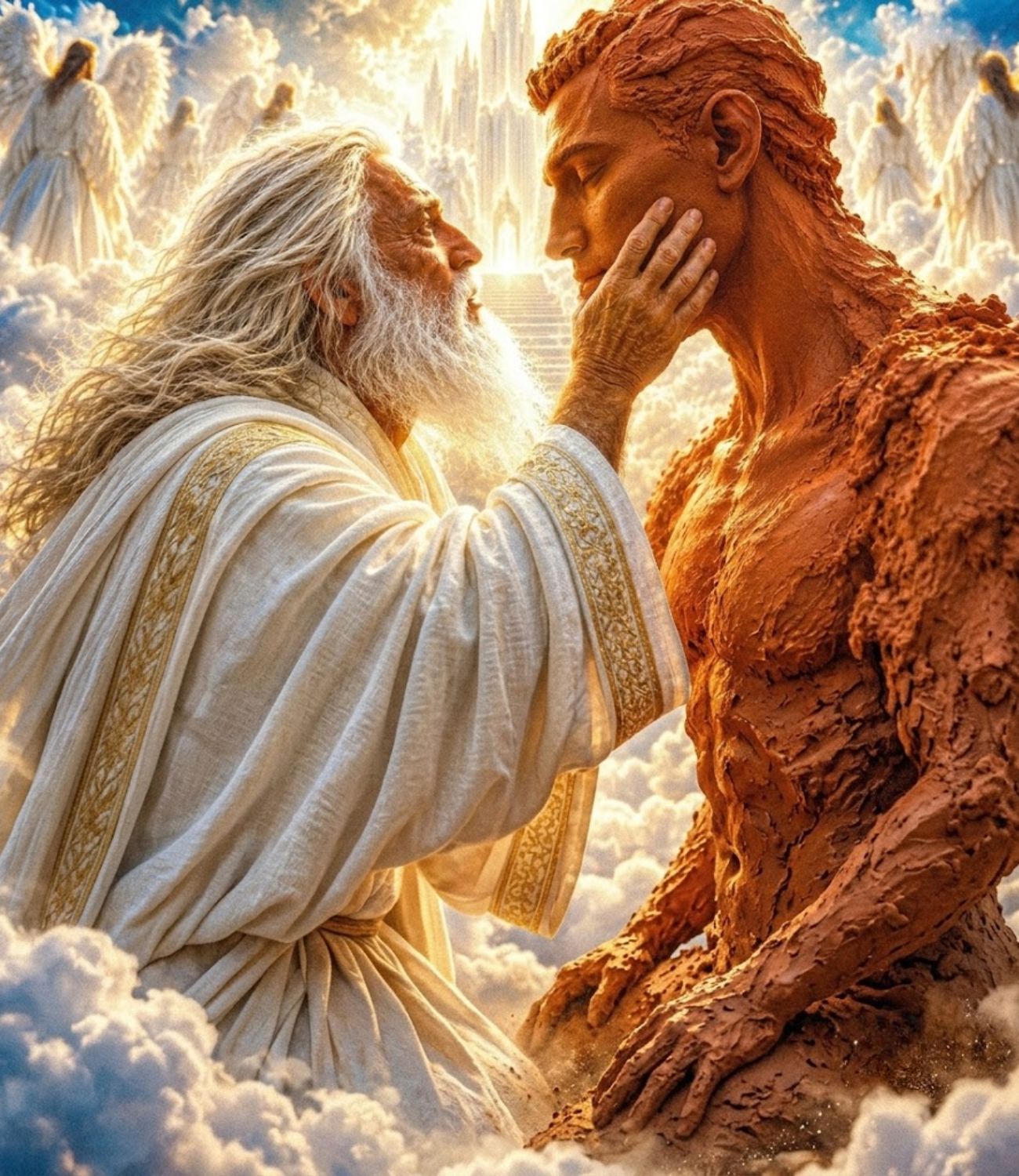
Why did God say, “Let us make man in our image?”
For five days and into the sixth, God had spoken only in commands. “Let there be light. Let the waters gather. Let the earth bring forth.” Then he came to man and he stopped. For the first time, he did not command. He spoke of himself. “Us, our.” One God speaking as more than one, and only when it came to you. That pause has troubled readers for 3,000 years.
So, this is the question: Who was God speaking to? What did he mean by image? And what does that make you?
The first chapter of the Bible has a rhythm, and once you hear it, you cannot stop hearing it. “And God said.” Ten times in one chapter. “Let there be light. Let the waters be gathered. Let the earth sprout vegetation.” Then the living things arrive and a second phrase begins to beat underneath the first: “According to its kind.” Ten times. Plants, sea creatures, birds, beasts of the earth, each according to its kind. And when it comes to the animals of the land, God does not even address them. He speaks to the ground: “Let the earth bring forth living creatures.” Command, kind. Command, kind. The same shape of sentence over and over for five days and most of a sixth.
And then the beat breaks. God does not command the earth. He does not say, “Let there be.” For the first time in the chapter, he speaks of, “Let us make man in our image, after our likeness.”
“So, God created man in his own image. In the image of God he created him. Male and female he created them.”
Notice what is missing. There is no “according to its kind.” Every other living thing is made after the pattern of its own species. Man is made after the pattern of God. Now, look closely at the grammar because the verse is stranger than it sounds in English. Verse 26 begins with a singular, “And God said,” one speaker. Then come three plurals in a row: “Let us make… in our image… after our likeness.” Then verse 27 answers with three singulars: “God created man… in the image of God he created him… male and female he created them.” The Hebrew verb is bara, to create, and it appears three times, each time with one subject: he.
Three plurals in the plan, three singulars in the act. And here is something easy to miss: This is the first time in the Bible that God speaks in the first person at all. Not “let there be,” but “let us.” The first time he says “I” comes three verses later, and he says it to human beings: “Behold, I have given you every plant.”
The verse troubled its readers from the beginning. An ancient Jewish commentary tells of Moses reaching this line as he wrote, and asking why God would give heretics an opening to say there was more than one creator. God answered him, “Write. Whoever wishes to err may err.” The rabbis also record that the elders who translated the Torah into Greek for an Egyptian king quietly changed this verse to, “I will make man.” The Greek manuscripts that survived still have the plural, but the story shows how uneasy this sentence made the people who loved it most. One God, one creator.
So, who is “us”?
Most people stop at that word, but there is a second word in this verse that should stop you even more. First, the plural. The most common answer, the one you have probably heard from a pulpit, is that God is speaking the way a king speaks. Monarchs say “we” when they mean “I.” So, God, the king of the universe, says, “Let us.” The problem is that the Bible’s kings do not talk like that. Pharaoh says, “I.” David says, “I.” Solomon says, “I.” When the most powerful king in the Old Testament, Nebuchadnezzar of Babylon, tells his own story, he says, “I, Nebuchadnezzar, was at ease in my house.” The standard reference grammar of biblical Hebrew rejects the “royal we” as an explanation of this verse for a simple reason: Hebrew kings do not speak that way. There is one debated exception, a letter from a Persian king in the book of Ezra, where he writes, “The letter you sent to us, and it has been read before me in the same breath.” Even there, the king slides back to “me” mid-sentence.
If you have watched this channel’s video on the names of God, you will know that the Hebrew word for God, Elohim, is itself plural in form. But that plural of majesty belongs to the noun, and the noun takes a singular verb all through the chapter. Here, in verse 26, it is the verb that is plural: “Let us make.” That is a different thing altogether.
Some scholars take a gentler route and say God is simply deliberating with himself, the way a person says, “Let’s see,” before a decision. It is a respected view, but no one deliberates with himself “in our image.” The plural possessive is left hanging. Whatever “us” means, it reaches outward, and the Bible says that someone was there when the world was made.
Picture a scene from the book of Kings. Two kings sit on two thrones at the gate of Samaria, Ahab and Jehoshaphat, with 400 prophets shouting victory in front of them. One prophet refuses to join in. His name is Micaiah, and when he is finally made to speak, he describes what he saw: “I saw the Lord sitting on his throne, and all the host of heaven standing beside him on his right hand and on his left.” And then God asks the room a question: “Who will entice Ahab?” One says this, another says that. A spirit steps forward and offers a plan, and God says, “Go.” A god who rules and who consults.
The book of Job says heaven was full on the day of creation. God asks Job, “Where were you when I laid the foundation of the earth? When the morning stars sang together, and all the sons of God shouted for joy?” There was an audience, and the closest parallel to Genesis 1:26 in the entire Bible is in the throne room of Isaiah chapter 6, verse 8. The prophet has seen the Lord high and lifted up, with seraphim crying holy. And then he hears a voice: “Whom shall I send, and who will go for us?” “I” and “us” in a single sentence from a single God surrounded by his court.
This is the oldest Jewish reading of the verse. Rashi, the 11th-century French rabbi whose commentary is still printed beside the text in Jewish Bibles, said God consulted the angels to teach humility. The greater should take counsel with the lesser. And Rashi, being honest, saw the problem with his own answer. He wrote that the text does not say “and they created,” but “and he created.” The angels were consulted. They did not do the work.
An older commentary adds a scene like a courtroom. When God prepared to make man, the angels divided. Love said, “Create him.” Truth said, “Do not, for he will be full of lies.” Peace said, “Do not, for he will be full of strife.” And God, the story says, cast truth to the ground and made man. That is tradition, not scripture, but it shows how seriously the rabbis took the plural.
Test the court reading the text and three things push back. First, verse 27: “he created,” singular three times. The court did not create. Second, Isaiah, speaking for God: “I am the Lord who made all things, who alone stretched out the heavens, who spread out the earth by myself.” Third, and most important: man is made in the image of God, not in the image of angels. If God had consulted his court, he did not share the pattern.
So, what does the court reading get right? That heaven was present. God did not make man in an empty room. That is what the Hebrew gives: a God who addresses a court and creates alone.
The first Christians looked at that same tension and saw something else. This channel has told that story in full in the video on Jesus before creation. So, here it is in brief. The early church fathers argued that when God said, “Let us,” he was speaking to someone distinct from himself, the Word through whom all things were made. One of them put it memorably: God needed no angels to make man. He made him with his own two hands, the Word and the Spirit. That reading is rooted in the chapter itself. Before anything is made, the only other figure named in Genesis 1 is the Spirit of God hovering over the face of the waters. And the Gospel of John, looking back at this chapter, says of the Word, “All things were made through him, and without him was not anything made that was made.”
So, does Genesis 1:26 prove the Trinity? Here is the honest answer: Not on its own. The first readers of Moses did not have the words of the later creeds, and the verse does not spell out three persons. What it does is leave a door open. A God who speaks as “us” and acts as “he,” plural in his counsel and single in his work. The rest of the Bible walks through that door.
So, put it together. A singular God speaks. A plural “us” is addressed. A singular God creates. The “us” did not create. Man bears the image of God, not of angels. And the “royal we” is not Hebrew. Two readings survived the test. The first: God spoke before his heavenly court as a king speaks before his council, and then did the work himself. The second: God spoke within himself because the creator was never solitary. Many Christian interpreters hold both at once.
Hold both for a moment. The rest of this story will show why the Bible may need both.
Whatever “us” means, the pause itself is the message. Count the ways this one creature is set apart in a single chapter. Man is the only creature God deliberates over. The only one not made according to its kind. The only one God makes directly, rather than commanding the earth to bring forth. The only one for whom the verb create appears three times in one verse. The only one given rule over the rest. The first one God speaks to: “And God said to them.” And only after man is made does God look at everything and call it “very good.” God never paused for the stars. He paused for you.
And every reading of “us” agrees on one thing. The plural lands on a single word: “In our image.”
That word is far more dangerous than “us.” The Hebrew word for image is selem. And if you search for that word through the rest of the Old Testament, you find it in a place that should make you sit up. It is the word for idols. When Moses told Israel what to do with the gods of Canaan, he said, “Destroy all their images.” The same word. When Baal’s temple was torn down in Jerusalem, it was his images the people broke. When Ezekiel described Israel’s unfaithfulness, it was images of men made of gold.
The word God chose for humanity on the sixth day is the word his prophets used for the statues he hated.
That was not an accident, and the ground has given up the proof. In 1979, at a place called Tell Fekheriyeh in northeastern Syria, a statue came out of the ground. A life-size figure of a ruler named Hadad-Yith’i, carved in black basalt, standing with his hands clasped in front of him. He lived in the 9th century before Christ, around the time of Elijah. And across the front and back of his robe runs an inscription in two languages, Akkadian and Aramaic, one of the oldest Aramaic inscriptions ever found.
The Aramaic text calls the statue two things. It calls it dmwt, a likeness, and it calls it clm, an image. Likeness and image, the two words of Genesis 1:26 carved on one king’s stone body. And the inscription tells you what the statue was for. The king set it up before his god in the god’s temple so that he would stand in the god’s presence and his prayers would be heard. A king placed his image where his god would see him. The statue stood in the temple so the king did not have to.
Whose image is this? In the ancient world, the answer was carved into the stone: The king’s.
While the statue is in front of you, settle a question people have argued over for centuries. What is the difference between image and likeness? Less than you might think. Genesis uses them almost interchangeably. One chapter says man was made in God’s likeness and leaves out image. Another says image and leaves out likeness. A third reverses the order. And on the king’s statue, both words describe one object. The simplest way to hold them: an image is the representation, and likeness says how closely it resembles the original. Together, they mean a true representative. Some of the early church fathers later split the two words apart, saying the image survived the fall and the likeness was lost. It is one tradition. Most readers since have taken the two words as one idea.
Now ask who was allowed to be an image. In the ancient world, the answer was narrow. A letter written to the Assyrian king Esarhaddon in the 7th century before Christ says it in one line: “A free man is as the shadow of god. The slave is as the shadow of a free man. But the king, he is like unto the very image of god.” In Egypt, the name of the most famous pharaoh of all, Tutankhamun, means “living image of Amun.”
The image of god was a title. It belonged to one man in the kingdom. And a king set up his image for a reason. Where he could not be present himself—in a far province or a distant temple—his statue stood for him. It carried his authority.
That is why the sentence in Genesis does not stop at image. It continues, “In our image, after our likeness, and let them have dominion. Let them rule.”
Then comes the revolution, and it is hidden in one small word: “Male and female he created them.” Not him, them.
Genesis takes the title that Egypt and Assyria reserved for one crowned man and hands it to every human being who has ever lived. The man and the woman. The servant and the child. The slave in the Assyrian letter, who was only the shadow of a shadow, carries the king’s title in this verse. The plural “us” makes a plural “them.” Nothing like it was said anywhere else in the ancient world.
Set that beside what Babylon believed. In the Babylonian creation story, mankind is made from the blood of a rebel god who was executed. And the reason is stated plainly: so that the toil of the gods could be laid on man. Babylon made mankind to carry the gods’ work. Genesis made mankind to carry God’s image.
There is one more thing the ancient world can show you, and it changes how you read the next chapter of Genesis. In Mesopotamia, when a craftsman finished carving an idol, it was not yet a god. It had to go through a night-long ritual called the washing of the mouth. The statue was taken down to the river. Its mouth was washed and opened. And the craftsmen who made it swore an oath that their hands had not made it. The statue, they said, was born of the gods.
Then open Genesis chapter 2. “The Lord God formed the man of dust from the ground and breathed into his nostrils the breath of life.” One recent study argues that Genesis is deliberately echoing those rituals. Whether or not that is so, the contrast stands. In Babylon, men carved a god and swore they had not. In Eden, God made a man and gave him his own breath.
Hear the verse again now, knowing what the word meant. “Let us make man in our image after our likeness and let them have dominion.” Only the king was God’s image. Genesis gave that title to everyone. So, human beings are God’s living statues.
But what part of a person is the statue? The mind? The work? The love?
For 2,000 years, that has been the next question. The church has given three answers, and each one is a picture.
The Mind: A mind that can know God. This is the oldest answer. The image is reason, conscience, a soul that can look up and seek its maker, something no animal does. It is a beautiful answer, and it has a limit. Genesis 1 never mentions the mind.
The Hand: A hand that rules for him. The verse itself says it: “In our image and let them have dominion.” On this reading, to be the image is to be God’s representative on the earth, as the king’s statue represented the king. This is the view most Old Testament scholars hold today. Its limit is that it explains the job more than the person.
The Face: A face turned to another face. “Male and female he created them.” On this reading, the image is relationship. A person is made for God and for others, and a human being alone is not the whole picture. Its limit is that it says less about the individual.
Most theologians today hold all three together, and that is probably the ancient Hebrew way of seeing it. The Hebrews did not divide a person into parts the way the Greeks later would. The image is not one faculty. It is the whole person made able to know God, called to represent him, made for each other. Take any one away and the picture is incomplete. A mind with no one to love, a ruler with no one to rule for, a relationship with no knowledge of the one who made it.
Which raises the question every viewer asks sooner or later. If human beings are made in God’s image, does God have a body?
Jesus answered that directly: “God is spirit.” But the Old Testament answers it in a way that is far more surprising. When Moses recalls the day Israel met God at the mountain, he says this in Deuteronomy chapter 4: “You saw no form on the day that the Lord spoke to you at Horeb. Beware lest you make a carved image for yourselves in the form of any figure, the likeness of male or female.”
Listen to the last words. “The likeness of male or female.” The Hebrew pair is the same pair as Genesis 1:27, male and female. Israel was forbidden to carve the likeness of a man or a woman as an image of God, and many readers have seen why. God had already made one, living, breathing, male and female. It is the strangest commandment in the ancient world. Every other nation filled its temples with images of its gods. Israel’s temple had no image of its God, and the reason was not that God had no image. It was that his image was already walking in the streets outside.
You may not make an image of God because you are one.
Now, hear that carefully because it can be misheard. An image is not the thing it shows. A statue of a king is not the king. The Bible said it to a king who forgot, the ruler of Tyre who called himself a god: “You are but a man and no god.” You are not God. You are the one thing in all creation made to show him. And an image is meant to show the one it represents.
So, what happens when the image starts pointing somewhere else or reaching for what an image can never be? The serpent’s offer in the garden was five words: “You will be like god.” Think about who heard it. Two people who were already made in God’s image, who already carried his likeness. The temptation was not to become something new. It was to grab the one thing an image can never be: the original.
And when they took it, the plural came back. “Behold, the man has become like one of us.” A few chapters later at the tower of Babel, it returns once more: “Come, let us go down.” Make of that what you will, but the divine “us” reappears exactly when humanity reaches upward.
So, did the image survive the fall?
The next chapter gives a hint. Adam fathered a son in his own likeness, after his image. And readers have taken that two ways: a damaged image passed down, or the image passed on intact. The decisive word comes later, after the fall and after the flood. When God gives Noah the first law of the new world, Genesis chapter 9, verse 6: “Whoever sheds the blood of man, by man shall his blood be shed. For God made man in his own image.” After Eden, after the flood, the image was still the reason a human life was sacred. James in the New Testament says people are still made in the likeness of God, which is why cursing them is a contradiction. And Paul says, “All have sinned and fall short of the glory of God.” Both are true. The image was cracked. It was not erased.
The image survived the flood. That single fact is the root of something the ancient world never had. The ancient law codes of Babylon set penalties by rank. An injury to a nobleman cost more than the same injury to a slave. Genesis 9 knows no ranks. Every human life is protected for one reason only: That God made man in his image. And that reason applies to the slave as much as to the king.
The rabbis found a way to say this that is worth keeping. In the oldest written collection of Jewish teaching, the Mishna, witnesses in a trial for life were warned with these words: “A man stamps many coins with one seal and they are all alike. But the King of kings stamped every human being with the seal of the first man, and not one of them is like another.” Hold on to that seal.
But an image that turns away from the one it represents does not stay still. Psalm 115 describes what happens: “Their idols are silver and gold, the work of human hands. They have mouths but do not speak. Eyes but do not see. Ears but do not hear.” And then the verdict: “Those who make them become like them. So do all who trust in them.”
You become what you worship. An image bent toward an idol begins to look like the idol. Mouths that do not speak. Eyes that do not see.
The book of Daniel shows it on the largest scale in the Bible. King Nebuchadnezzar of Babylon made a golden image 60 cubits high and set it up on the plain of Dura. He gathered every official in the empire and gave the order: When the music plays, every people, nation, and language must fall down and worship what his hands had made. The text never says whose face was on it. The music played, the plain bowed. Three men stood. Three Jews named Shadrach, Meshach, and Abednego, who would not give to a king’s image what belonged to God. When the king heard, the Aramaic says that the image of his face changed, and it uses the same word, selem. The king who had made an image had become one, and the image was of his rage. He heated the furnace seven times hotter and had them thrown in. And he saw four men walking in the fire. The fourth, like a son of the gods. Who that fourth figure was, Christians have had their own answer. The text leaves it open. What it does not leave open is this: Men who carried God’s image would not bow to a king’s.
Sin damaged the image. It is still there in every face. And for centuries the question hung over every cracked image on the earth: What would an uncracked one look like?
Paul answered that question in one sentence, writing to the church at Colossae, chapter 1, verse 15: “He is the image of the invisible God.” The Greek word is eikon. It is the very word the Greek translation of the Old Testament had used centuries earlier for image in Genesis 1:26. Paul reached for the oldest word in the Bible story and put it on Jesus. Not an image, the image. Not made in it, he is it.
Think about what that means. A king’s statue stood in a temple so that a god could see the king. Here was the reverse: God himself standing in the world so that men could see God. Everything Adam was made to be—a visible representative of the invisible God—Jesus was with no crack in him. When his disciples asked him to show them the Father, he told them they were already looking at him.
And hold the two Adams side by side. The first was offered one thing in the garden: “You will be like God.” He reached for it and the image cracked. The last Adam already was God and he let go. He emptied himself, took the form of a servant, and died. The first image grabbed; the true image gave himself away. And in doing so, he showed what the image had been for from the beginning. Not to be like God in power, but to show God in love.
Now go back to the Psalm. “Those who make idols become like them.” You become what you worship. Paul took that law and turned it around in his second letter to Corinth, chapter 3, verse 18: “We all, with unveiled face, beholding the glory of the Lord, are being transformed into the same image.”
The same image. The same word. The Psalm said, “Look at an idol and you will come to resemble it.” Paul says, “So look at him.” And listen to how he describes what happens to a person who does. Not improved, not repaired. The new self, he writes, is being renewed after the image of its creator. The image of its creator. That is Genesis 1 spoken over a convert. The image given in the garden is not patched up in Christ. It is given back. Being renewed in the present tense. The finishing comes later, but it has begun.
Then remember the king’s statue one last time, standing in the temple where the king himself could not be seen. That is what the restored image is for. Jesus said it on a hillside before any of this was written: “Let your light shine before others, so that they may see your good works and give glory to your Father who is in heaven.” Not glory to you, to your Father, because that is what an image is for. People are meant to see God through it. Through you.
Jesus is what Adam was meant to be. In him, the image is being restored, and the man or woman who carries it stands in the world as God’s image again so that others can see him there.
And once, in the last week of his life, he held an image in his hand and asked a question. They came to trap him with a question about taxes. If he said pay Caesar, he would lose the crowd. If he said refuse, Rome would have him. Jesus asked for a coin. “Bring me a denarius and let me look at it.” Someone handed him one and he held it up. “Whose image is this?”
“Caesar’s,” they said. The coin most likely in his hand that day carried the face of the emperor Tiberius with an inscription calling him the son of the divine Augustus. A man’s face and a claim to be a god’s son stamped in silver. The most powerful man on earth calling himself the image of a god, just as kings had done for 2,000 years.
“Render to Caesar the things that are Caesar’s,” Jesus said, “and to God the things that are God’s.” An early Christian writer named Tertullian heard what everyone in that crowd would have heard. The coin bore Caesar’s image, so it belonged to Caesar. And what bears God’s image? “To Caesar money,” he wrote, “to God yourself.”
Now hear what that means for you, because the Bible says there are two images a human being can carry, and Paul names them both in one sentence. “As we have borne the image of the man of dust, we shall also bear the image of the man of heaven.” Outside Christ, every person on earth carries the image of the first Adam. It is real. It is precious. It is why every life is sacred, and it is fallen. That is why there is dignity in every face and ruin in every heart. No one can carve that image straight again from the inside. The craftsmen of Babylon could wash a statue’s mouth all night, and it would still be stone. But in Christ, the last Adam, the original is given back. Not a better version of the old self, a new creation, renewed after the image of its creator.
And listen to the word Paul chooses. When he calls Jesus the image of the invisible God, the word is eikon. When he says believers are being transformed into the same image, the word is eikon. When he says God is conforming his children to the image of his Son, the word is eikon. The same word. The word for Jesus is the word for you.
If you are in Christ, you are not trying to become God’s image, you are his image being made new, and the work is his. That is why the door is open to anyone. John wrote it plainly: “To all who did receive him, who believed in his name, he gave the right to become children of God.” Not the right to earn it, the right to receive it. The door is the one God opened on the sixth day, and then walked through himself, the image of God, offering his image to anyone who will take it from his hand.
So, look at the face in your mirror tomorrow morning. It carries the stamp, and your worth was stamped on you before you had done anything at all. If you belong to Christ, that face is being renewed after the image of the one who made it, and people are meant to see him there. So does every face you will pass in the street. The Bible says that to wrong one of them is to insult their maker, and you become what you behold. So look at him until the day John promised: “We shall be like him because we shall see him as he is.” The last sight finishes the image.
Hear the verse one last time. “Let us make man in our image after our likeness.”
The one God, never alone, paused over his last work, spoke of it before heaven, and made a creature to carry his image into the world. When that image cracked, the image himself came to stamp it on mankind again, and to stand in the world through everyone who carries it. Caesar stamped his image on a coin. God stamped his on you.
Jesus is the image of the invisible God, and yet days before he died, he told his disciples something that has puzzled readers ever since. “The Father is greater than I.” How can the image of God say that about the God he images? The answer is in the video on your screen now. And if this channel helps you see the Bible more clearly, subscribe so the next one finds you.