The Last 3 Minutes Before Death: What Really Happens to Your Body and Brain
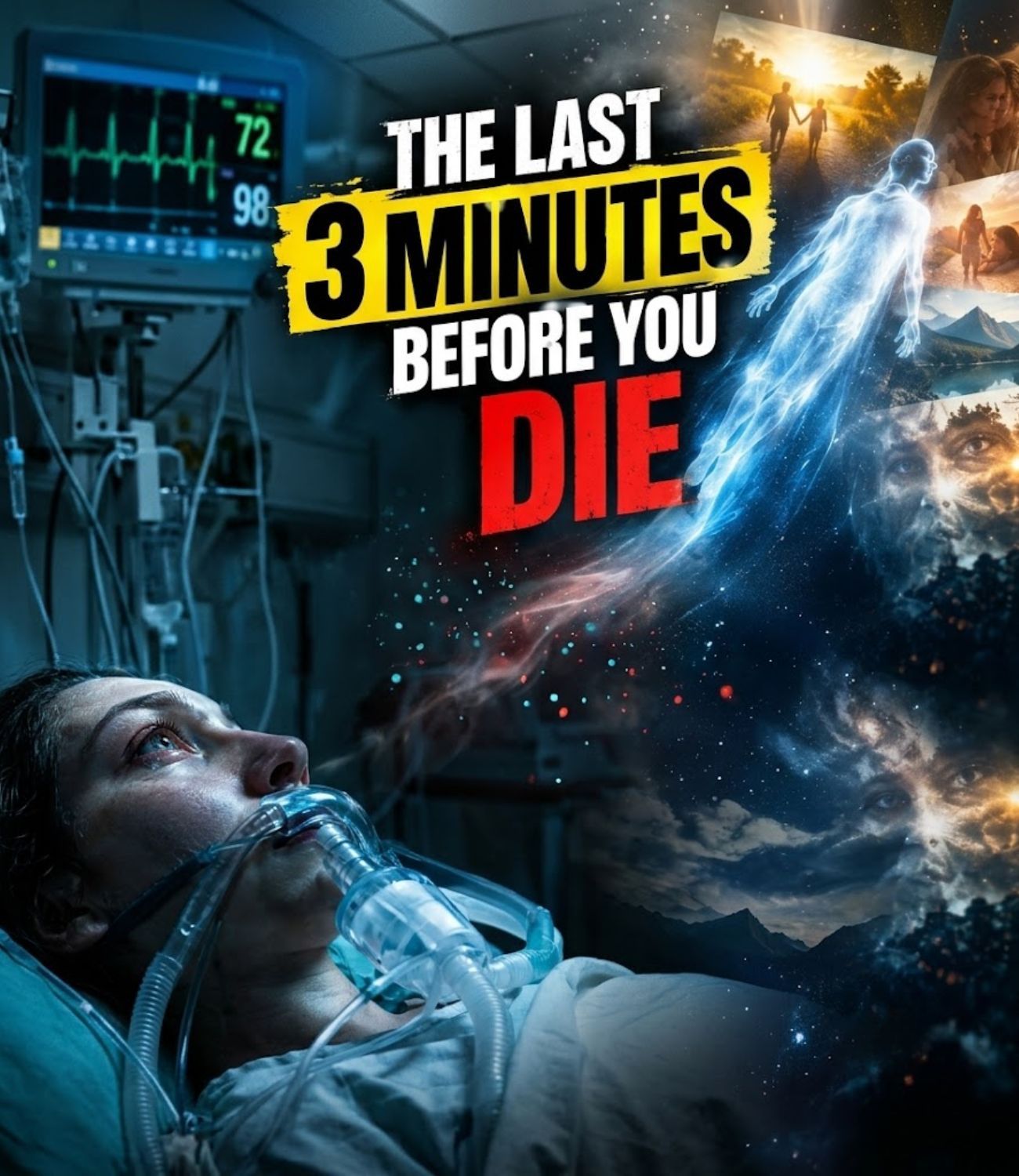
Most people imagine death as a single moment. One second someone is here, the next, they are gone. But in a natural death, the body usually does not stop all at once. It withdraws in stages. Circulation weakens, breathing changes, consciousness fades, and the distance between one breath and the next begins to grow, until eventually there is one final exhale.
No two deaths follow exactly the same clock. There is no medical stopwatch that can honestly say, “At 2 minutes and 14 seconds, this will happen to everyone.” But there are patterns—patterns doctors, nurses, hospice workers, and families have witnessed again and again at the edge of life.
In this video, we are going to follow the final 3 minutes before death, second by second, system by system. What happens when the heart can no longer keep blood moving? Why does breathing become slow, irregular, and sometimes disturbingly loud? Does the brain simply switch off, or could there be a final flicker of awareness? And what, if anything, might a person still hear or experience? This is not speculation. It is what medicine can observe, and what science still cannot fully explain.
The final 3 minutes begin. Now.
The final 3 minutes do not begin in isolation. They are usually preceded by hours, days, and sometimes longer periods in which the body is already conserving energy. The person sleeps more. They may drift in and out of consciousness. They usually eat and drink less because the body is no longer asking for fuel in the same way. Blood pressure falls. The pulse becomes weaker. Hands and feet can turn cool, pale, dusky, or mottled as circulation to the skin decreases.
To the family, this can look as if the person is fading away. Biologically, that is close to what is happening. The body is no longer investing energy in digestion, movement, conversation, or maintaining warm hands and feet. Its priorities are narrowing.
The brain’s level of wakefulness falls. A person may still open their eyes briefly, squeeze a hand, speak a few disconnected words, or seem to look towards someone who is not visible to others. These experiences are real to the person having them. But medicine cannot reliably tell us what every individual is perceiving. Sometimes people appear restless. Sometimes they are unusually calm. Sometimes they seem to be in a state halfway between dreaming and waking.
And then, there is the breathing. In the final hours, the breath often becomes less regular. It may be shallow, then deeper. Fast, then slow. There may be long pauses. This is often called Cheyne-Stokes breathing: waves of breathing separated by intervals of little or no breathing. For those watching, every pause can feel like the end. And then, another breath comes.
One of the most unsettling sounds can be a wet, rattling, or gurgling breath. It is often called the “death rattle.” Despite the name, it is not the sound of a person choking. As swallowing and coughing weaken, ordinary saliva and secretions can collect at the back of the throat or upper airways. Air moving through those secretions makes the sound. It can be distressing for family members, but clinical guidance emphasizes that, although it sounds alarming, it is unlikely to be uncomfortable for a person who is deeply drowsy or unconscious. That difference matters. The sound is often louder in the room than it is in the dying person’s experience.
Now, imagine we are approaching the final 3 minutes. Not an exact clock. A window.
The heart is weaker now. With each contraction, it pushes less blood through the body. Blood pressure is low. The pulse may be rapid and thready, slow and irregular, or too weak to feel at the wrist. Because circulation is failing, the skin may cool. The lips may look pale or bluish. The hands and feet may show a blotchy, marbled pattern called mottling. This is not necessarily a sign of pain. It is evidence of reduced blood flow near the surface of the body.
At this point, consciousness is often already deeply altered. The person may no longer respond when spoken to. Their eyes may remain partly open. Their jaw may relax. The muscles of the face may lose their usual tension. But unresponsiveness does not prove absolute absence of perception. A small EEG study of hospice patients found that some unresponsive people near death still showed brain responses to sound patterns. That does not prove they understood words, recognized loved ones, or had a fully conscious experience. But it supports the compassionate practice used in hospice care around the world:
Keep speaking gently. Keep saying who you are. Keep saying what you need to say.
As blood flow and oxygen delivery fall, the brain does not simply switch off like a light. Different systems fail at different rates. The parts of the brain that support complex conversation, deliberate movement, attention, and memory formation are highly energy-demanding. As oxygen and circulation decline, these functions often fade. That is why someone may become quiet, confused, sleepy, or impossible to rouse.
But more automatic systems can persist longer. The brainstem, the ancient machinery that helps regulate breathing and basic reflexes, may continue producing respiratory rhythms even when the person can no longer speak or respond. Palliative care physician and author Kathryn Mannix describes the end of life as a process in which sleepiness gradually deepens into unconsciousness. In her account, hearing and breathing may be among the last functions still operating even as the rest of the body is shutting down. This is one reason a person may seem completely absent, yet still react subtly to a familiar voice, a touch, or a sound.
We should be careful, though. There is a difference between brain activity, sensory processing, and conscious experience. They are not the same thing. A brain can respond to sound without a person necessarily understanding it. A brain can produce electrical patterns without generating a clear inner world. And an observer at the bedside cannot know exactly what another person is seeing, remembering, or feeling.
So, does a dying person see their life flash before their eyes?
Science cannot say that this is a universal event. Some people who survived near-death medical crises report memories, lights, loved ones, a sense of peace, or vivid dream-like experiences. But there is a fundamental limit: these are reports from survivors. We cannot ask someone who did not survive what they experienced.
There have also been small studies showing brief surges of organized gamma frequency brain activity in some dying patients after life support was withdrawn. Gamma activity is associated with certain aspects of conscious processing in living brains. But these studies are tiny, and they do not prove that a person was seeing images, reliving memories, or having a near-death experience. The honest answer is more fascinating than a false certainty. At the edge of death, the brain may still be active in ways we do not yet fully understand. But nobody can responsibly claim to know the final private images inside every dying mind.
Now the pauses grow longer. One breath, silence, another breath. The pattern can be frightening because it feels unpredictable. The body is no longer maintaining the smooth rhythm of ordinary breathing. Carbon dioxide rises, oxygen falls. The respiratory control centers are becoming less stable. A breath may be shallow and quiet, then suddenly deep, then absent for several seconds, sometimes longer. The final breaths may involve visible movement of the jaw or neck. They may look effortful to the observer.
In palliative medicine, these changes are recognized as possible signs that death is very near. But appearance can deceive. A dramatic-looking breath is not automatically evidence of conscious suffering. Someone who is deeply unconscious may still display reflexive respiratory movements. The body can continue patterns of breathing even when conscious awareness has faded far away.
If you were at the bedside, this would be the moment to resist the urge to demand a response. Do not ask them to fight. Do not force food, water, or conversation. Instead, be present. Say simple things:
“I’m here.”
“You’re safe.”
“Thank you.”
“I love you.”
Clinical teams may reposition the person for comfort, moisten the mouth, manage pain or breathlessness, and support the family through the sounds and pauses of the final stage. The goal is not to make death look tidy. The goal is comfort.
In the final 30 seconds, there may be no clean countdown. There may be a long pause that feels final. Then, another breath or two. Some people take a final deeper inhale or exhale after everyone in the room believes breathing has already stopped. This is why families sometimes describe a “last sigh.” It can also be followed by a soft sound from air moving through relaxed tissues or remaining secretions. It is not a message. It is not necessarily a sign that the person has returned to consciousness. It is the body completing one of its last reflexive acts.
As the final breaths end, oxygen delivery to the brain collapses. The heart may still beat briefly after breathing stops, or it may stop first, depending on the underlying illness and the sequence of organ failure. At this stage, a person is generally not responding to the world in the ordinary sense. And yet, this is exactly why compassionate care treats the moment with reverence. Not because science has proven a final hidden awareness, but because we do not need certainty to be kind.
And then, no more breath comes. The chest does not rise again. The pulse disappears. Blood stops moving.
Without circulation, the brain can no longer sustain its electrical and chemical activity. Cells begin the irreversible transition from living tissue to tissue without oxygen. The body relaxes. The face may look unexpectedly peaceful or simply unfamiliar because the small movements of breathing are gone. In the minutes after death, the skin can become pale or waxen as blood settles. The pupils may become fixed and dilated. The body temperature begins to fall. Rigor mortis, the stiffening of muscles, usually begins later over hours, not in the first few minutes.
For people in the room, this can feel impossible. The person looks almost the same. The body is still there, but the relationship has changed. This is the boundary that medicine can describe with vital signs, reflexes, circulation, and brain function. And what lies beyond that boundary remains a question science cannot answer.
We know that natural dying often involves increasing sleepiness, reduced awareness, weaker circulation, cooler skin, irregular breathing, pauses, and eventually the cessation of breathing and heartbeat.
We know that the noisy breathing called the death rattle is commonly caused by secretions that can no longer be swallowed or coughed away, and that it is usually more distressing to hear than it is for the dying person to experience.
We know that some unresponsive hospice patients show signs of auditory processing near death.
And we know that a few small studies have found intriguing bursts of organized brain activity close to death.
But we do not know whether everyone hears until the end. We do not know whether everyone dreams. We do not know whether a final surge of brain activity creates visions, memories, fear, peace, or nothing that can later be reported.
The last moments of consciousness remain private. And perhaps that is why the most human response is not to force an answer. It is to offer presence.